



Disregarded LLC

Free disregarded box read

Disregarded LLC? Match the box they sent.

Four taps. Their sentence against the return you signed.

Their box. The return decides.

Question 1 of 4

Who put this question on the screen?

Question 2 of 4

How many names own the company?

Question 3 of 4

Where did last year's profit land?

Question 4 of 4

What have you done with their box?

Your free box read is ready to start. Where should we reach you?

    You will be talking to the Steven Palmieri practice.

    Next you pick a time for a free video call with the Steven Palmieri practice. Nothing to sign, nothing to pay.

    Prefer to read first? It's all below ↓

    Disregarded LLC Their form asked a yes or no

    A bank, a marketplace, or a payroll company put a yes or no on your screen. Steven Palmieri, the Tax CFO, reads that question against the return you already signed, and tells you which box matches.

    Disregarded LLC, typed, with the cursor still blinking.

    Send their form

    Name their form

    Tell us the sentence on their screen.

    You will be talking to the Steven Palmieri practice.

    A form reader answers the box. A Tax CFO asks if the box should change.

    Anyone can tell you which box matches the return you signed. The Tax CFO asks the question behind it. Is the status you have the one the year wants? If a change is worth it, it is made on purpose, with the real form, in October, when there is time to aim the books at it.

    A grey check beside a gold question that becomes an October calendar.
    A printed return page with a signature

    What they are actually asking

    The bank's onboarding screen is one checkbox about the income-tax life already in force.

    Click to read what they asked ›Tap to read what they asked ›
    A state certificate in a frame on an office wall

    A yes leaves the company standing

    A yes does not dissolve anything. The company you formed still stands. The box is about how the income is taxed, and a yes leaves the state filing where it was.

    Click to see what a yes leaves ›Tap to see what a yes leaves ›
    A phone screen with a no toggle

    A no can point the wrong way

    The marketplace tax-info page can ask the same words and point at a corporate return.

    Click to see what a no signals ›Tap to see what a no signals ›
    Hands on a laptop whose screen is an application form

    When the form is about payday

    The payroll enrollment asks the same words and means payday, not the income-tax box.

    Click to pause a payday form ›Tap to pause a payday form ›
    Two signatures on one page

    Two names on the certificate

    If two names are on the certificate, the single-owner box is the wrong one, and checking it starts a different return. We count the names before the box is touched.

    Click to count the names ›Tap to count the names ›
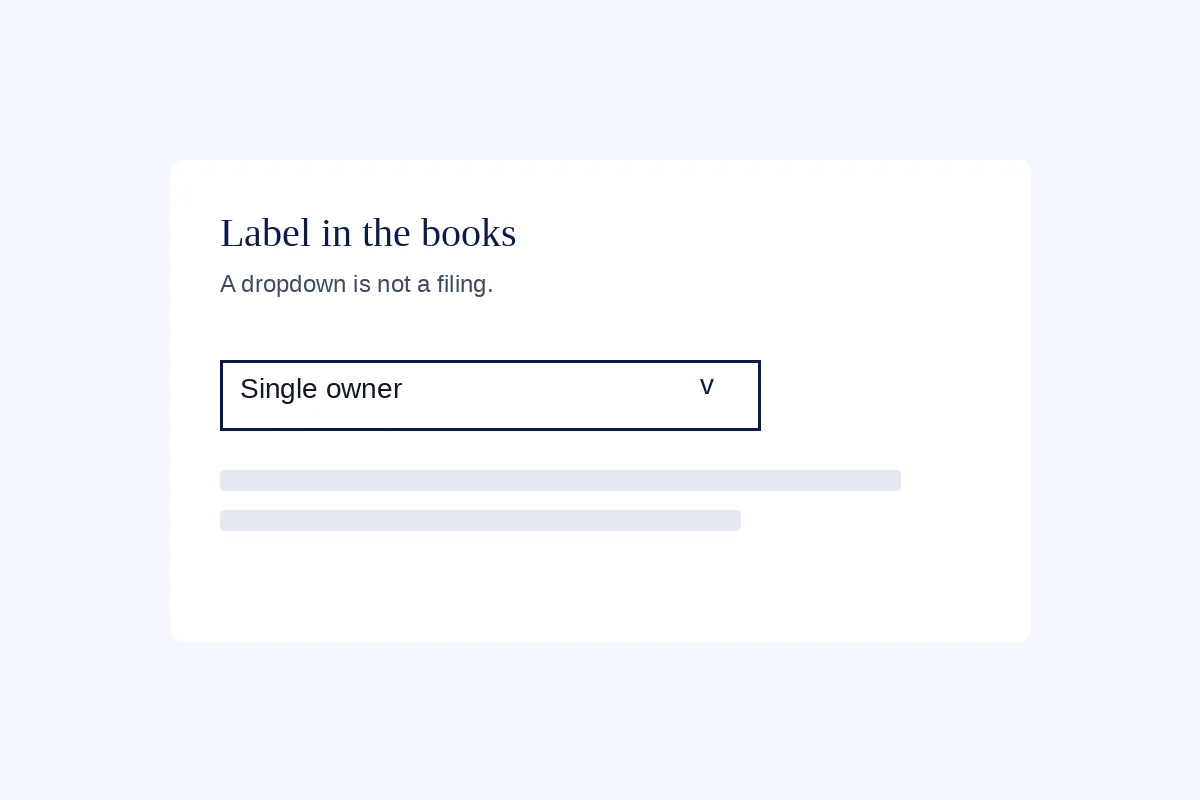
    A bookkeeping dropdown set to single owner

    The label inside the books

    The dropdown in your bookkeeping software is a label, not a filing. It is ready only when it agrees with the return you signed.

    Click to match the label ›Tap to match the label ›

    Six forms that get mixed together

    Open one card.

    1. 1Marketplace asked tonight

      We read their sentence beside the return you signed

      A checkbox on their screen does not rewrite the company you formed.

    2. 2They want a reviewed statement

      We split that request from the yes or no

      Reading the box is work we can do. An assurance signature leaves this practice.

    3. 3Payroll used the same words

      We pause the enrollment

      How the company is taxed and how payday is set up are different questions. Whoever already runs payday for this company keeps the deposits too.

    4. 4Two names on the certificate

      We count the owners before the box

      Two owners usually take the form down a different road than one owner does.

    5. 5The software label disagrees

      We treat the signed return as the tie breaker

      A dropdown can be corrected. It does not call for a new company.

    6. 6They want a different answer

      We ask whether an election is even the next step

      Their checkbox cannot elect a new status. October is when a real election can still be considered.

    Open their form.

    Steven Palmieri, Tax CFO

    Who reads their form

    The vendor sentence and the signed return pick the box.

    Send both papers

    Their wording and the return you signed are the pair we read.

    You will be talking to the Steven Palmieri practice.

    The company is still there

    A calculator and a yellow pencil on graph paper, with a keyboard behind
    What the count is for

    An accountant can count which box matches the return you already signed. A Tax CFO decides what the company does next. If this year wants a different status, the change is a real form, filed on purpose, while October still leaves time to aim the books.

    The fear that the company vanished is the feeling this page is for. You will still find that certificate in the drawer where you left it. The return you signed is still the answer. The close still has its day.

    What the two papers are for

    The company is older than their form, and the return you signed is older still. The monthly close stays on a day you can name, on a video call, wherever the company was formed.

    You did not open this page to collect a glossary. Someone else put a legal-sounding box in front of you, and the wrong answer feels like it might erase the company or invent a new one. The certificate and the signed return are the only two papers the first conversation needs.

    If you stay, the books close on a day you can name, so the label in the software and that return keep telling the same story. If a real change of tax status is actually the next step, October is the month to look while the year can still be shaped. We will not check their box for you.

    Does a yes dissolve the company?

    No. A yes on a vendor form is a statement about income tax, and only when it matches the status you already have. The Secretary of State record is a different paper. Paying someone to amend the certificate because a marketplace asked a question is a cost with nothing under it. Read the page on what a yes leaves standing before you pay that invoice.

    The same vendor sometimes asks, in the next sentence, for a reviewed set of statements. That sentence is not the box. A reviewed or audited report is a signature we hand to a firm that is allowed to give it. We can still read the classification question. Mixing the two asks is how a simple form turns into a project nobody priced.

    What if two names are on the certificate?

    Count them before you answer. A company with one owner and a company with two owners do not share a default income-tax life. Checking yes because the business feels small is how a partnership year gets described as if it belonged on one person's return. Spouses who both own the company are a facts question of their own, and this page does not decide it. Bring the certificate, or say how the names sit on it, and leave the box blank until that count is real.

    Bring the certificate, or say how many people signed it. If a corporate election was filed on purpose in an earlier year, say that too. The honest box follows those facts. It does not follow the mood of the evening.

    A checkbox is not an election

    Software makes a dropdown feel like a filing. It is not. A new income-tax status takes the IRS form that belongs to it, signed and sent on purpose. Their vendor box is not that form. If you need a different answer than the return you already filed, the next step is to ask whether an election belongs in this year at all, and to read the instructions before anyone touches their screen.

    What to gather before you answer

    Two things. The sentence they wrote, copied in your own words if you would rather not send the file yet. And the return that was signed. If no return exists, the answer is not a guess. It is a stop, and the stop is useful. Leave their box blank until the pair exists or until someone has told you, from the facts, that there is nothing to file yet.